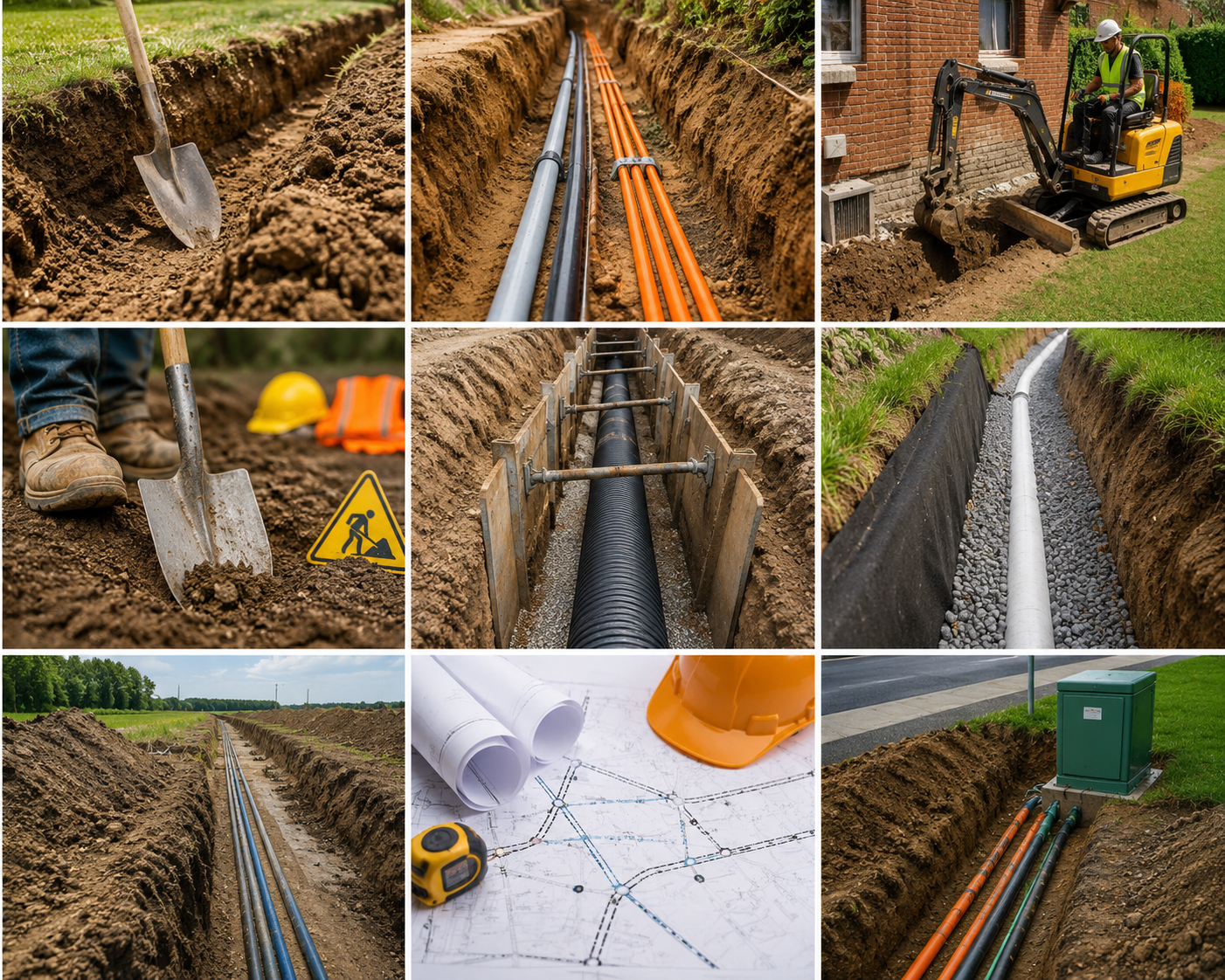
Long underground utility runs present different challenges from short excavation projects. As the distance increases, small errors in alignment, depth, route selection, and soil management can become much more noticeable. Changes in terrain and ground conditions are also more likely to occur along an extended excavation path.
Before workers dig trenches across a longer section of property, the entire route should be evaluated carefully. Breaking the project into manageable sections, checking measurements regularly, preparing for changing soil, and organizing excavated material can make the work more predictable from beginning to end.
Survey the Complete Route First
A long trench should not be planned by looking only at its starting and ending points.
Walk the complete proposed path and note every significant property feature along the way. Trees, driveways, gardens, walkways, fences, slopes, retaining structures, and buildings may influence the route.
A detailed survey can reveal challenges that are easy to miss when viewing the project from a distance.
Compare Alternative Paths
The shortest route is not necessarily the most efficient.
A direct line might cross several difficult areas, while a slightly longer alternative could remain on more accessible ground. Consider excavation difficulty, property disturbance, equipment access, and restoration when comparing routes.
Making this decision before excavation can prevent major changes later.
Identify Underground Infrastructure
The longer the excavation route, the greater the possibility of crossing existing underground infrastructure.
Electrical connections, water lines, drainage components, communication infrastructure, and other buried systems may be present along different sections of the property. These should be properly identified before excavation starts.
Do not assume that one clear section means the entire route is free from underground obstacles.
Review Each Section Separately
Dividing a long route into smaller sections can make planning easier.
One area might cross an open lawn, another may pass near landscaping, and another could approach a driveway or structure. Treating these sections according to their individual conditions can improve excavation control.
This approach also helps organize measurements and soil management.
Establish Reference Points
Maintaining alignment becomes increasingly important as trench length increases.
Small directional errors near the beginning can result in a significant difference farther along the route. Clear markings and reference points can help workers maintain the intended path.
When workers dig trenches across changing terrain, these references become particularly valuable.
Check Depth Frequently
Surface elevations may change gradually across a long property.
A trench that appears visually consistent may actually vary significantly in depth. Regular measurements help maintain the required excavation dimensions despite changes in the surrounding ground.
Frequent checking also allows corrections to be made while they are still relatively small.
Prepare for Changing Soil Conditions
Long utility runs may pass through several types of ground.
Clay could appear in one section, while another contains sand, gravel, compacted fill, rocks, or roots. Previously disturbed areas may behave differently from natural soil.
The excavation approach should remain flexible enough to accommodate these changes.
Consider Moisture Differences
Moisture conditions can also vary across the route.
Low sections may remain wet even when higher areas are relatively dry. Poor drainage can create soft ground, while other sections may be firm and compacted.
Observing these differences beforehand can help with excavation planning and equipment access.
Manage Excavated Soil by Section
Long trenches generate substantial amounts of removed material.
Placing all excavated soil without a clear system can quickly make the work area difficult to navigate. Instead, material can be organized according to the section from which it was removed.
This can simplify backfilling and help keep suitable soil available near the appropriate area.
Keep Access Routes Open
Soil piles should not block the path needed for workers or equipment.
They should also be positioned carefully around lawns, gardens, driveways, and drainage routes. Thoughtful placement can reduce additional property damage beyond the excavation itself.
Roots, debris, large rocks, and unsuitable material should be separated when necessary.
Coordinate Excavation With Installation
Opening an extremely long trench before beginning the underground installation may not always be the most practical approach.
Coordinating excavation and installation in planned stages can help keep the work area manageable. Completed sections can be reviewed before attention moves farther along the route.
Good sequencing also helps reduce the amount of disturbed ground exposed at one time.
Inspect Before Backfilling
Each completed section should be checked before it is closed.
Confirm alignment, dimensions, and completion of the underground work. Problems are much easier to address while the excavation remains accessible.
Once everything is verified, backfilling can proceed according to the site’s requirements.
Prevent Uneven Settlement
Settlement can become especially visible along a long trench route.
If backfill is inconsistent, some sections may remain stable while others develop noticeable depressions. Careful material placement and appropriate compaction help create more uniform conditions.
The finished ground should be checked for changes in elevation throughout the entire route.
Restore Drainage and Surface Conditions
Long excavations may cross several natural drainage paths.
Final grading should avoid creating a continuous depression that collects or redirects runoff. Existing slopes and surface drainage patterns should be restored as closely as practical.
Different sections may also require different surface treatments.
A lawn area may need topsoil and reseeding, while gravel, bare soil, or landscaped sections require other restoration methods.
Inspect the Route After Completion
Rainfall provides a useful test of the restored ground.
Walk the completed route and look for settlement, standing water, erosion, or unexpected runoff. Early identification allows minor surface adjustments before they develop into larger problems.
Conclusion
Long utility runs require consistent planning across a much greater distance than smaller excavation projects. Route selection, underground infrastructure, reference points, soil changes, moisture, material storage, and installation sequencing all become increasingly important as trench length grows.
When workers dig trenches with regular measurements and section-by-section organization, they can maintain better control over an extended excavation. Careful backfilling, grading, and final inspection then help create a stable surface while supporting the underground installation for the long term.